Python setup, types and expressions
Set up an environment for running Python and compare common ways of executing a program.
Explore the course learning plan Training & Capability DevelopmentLearn. Practise. Apply.⌕
Write Python programs using variables, conditions, loops and functions.
The Python Essentials course is designed to provide a strong foundation in Python programming.
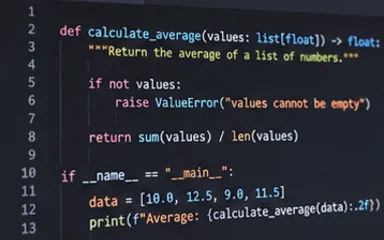
Set up an environment for running Python and compare common ways of executing a program.
Explore the course learning planExplore List operations, indexing, and slicing and Operations and methods for tuples and dictionaries.
Explore the course learning planRevisit the language concepts from earlier sessions and use them in a mini-project.
Explore the course learning planSet up an environment for running Python and compare common ways of executing a program. Work with basic types, variables and expressions to see how Python represents values and evaluates operations. These foundations support the more structured programs developed in the following days. Trace how the language construct affects execution and data handling, relating the example to code that another developer can read, reason about and maintain.
Examine how Python handles text and bytes and when the distinction matters to a program. Continue with the decisions and repetition used to control how code runs. Relate those concepts to working through a task with different inputs rather than running the same statement once. Connect the language features to the problem the code is intended to solve, tracing how inputs, program structure and execution produce the resulting behaviour.
Explore List operations, indexing, and slicing and Operations and methods for tuples and dictionaries. They then set operations like union, intersection, and difference. The section also examines File methods and block styles. Connect the language features to the problem the code is intended to solve, tracing how inputs, program structure and execution produce the resulting behaviour.
Explore Argument categories and global vs return, Importing modules, pip, and package creation, and try, except, and raising exceptions. The discussion covers List comprehension, lambda, map, filter, and reduce. Connect the language features to the problem the code is intended to solve, tracing how inputs, program structure and execution produce the resulting behaviour.
Revisit the language concepts from earlier sessions and use them in a mini-project. Work through implementation and completion, then present what the program does and how it is organised. The final assessment and review consolidate the choices made while turning a task into a working Python solution. Connect the language features to the problem the code is intended to solve, tracing how inputs, program structure and execution produce the resulting behaviour.
Need the detailed syllabus? Request the course outline.
Check the course fit for your role and experience. Confirm the prerequisites, delivery scope and preparation before booking.
Check the full outline for this course’s tools and technologies. Confirm software versions, licences, accounts, equipment, access and installation requirements before joining.
Ask which preparation materials, follow-up resources or trainer support are included in your selected delivery.
Confirm the certificate, completion requirements and any assessed activities for your selected batch. A practical project does not by itself establish an assessed skills award.
Understand certificates and assessments →Confirm dates, venue, fees, available seats and delivery arrangements with Timmins before booking.
Ask Timmins about upcoming dates for this course.
View the public training calendar →Ask about another date or team delivery. Share your preferred timeframe, city or delivery mode and participant numbers. Timmins will discuss the options; dates, trainer availability, delivery and fees must be confirmed separately. Sending an enquiry does not reserve a place or confirm a class.
Your selected course is included in the draft. Review it and press Send in your messaging app.
Share your role, experience and intended workplace application with Timmins to confirm whether this course is suitable.
Basic understanding of programming concepts is recommended. Familiarity with any programming language is beneficial but not mandatory.
Check the full outline for this course’s tools and technologies. Confirm software versions, licences, accounts, equipment, access and installation requirements before joining.
The learning plan describes the course topics and activities in the published summary. Ask Timmins to confirm the exercises, trainer feedback and any assessed activities for your selected delivery. Completion and assessed credentials have different requirements.
AI-assisted activities are not listed in this course summary. Ask Timmins to confirm the scope of your selected delivery rather than assuming AI tools are included.
Discuss an in-house programme with Timmins. Share the team’s roles, starting knowledge and workplace challenges. Agree any adaptations, assessment and follow-up support in the proposal.