Playwright setup and foundations
Review the Playwright architecture and set up the TypeScript project.
Explore the course learning plan Training & Capability DevelopmentLearn. Practise. Apply.⌕
Build repeatable Playwright checks with locators, assertions and trace debugging.
Build Playwright v1.4x tests in TypeScript with Cucumber. Learn to interact with web applications, debug with tracing, validate APIs and organise tests for Jenkins execution.
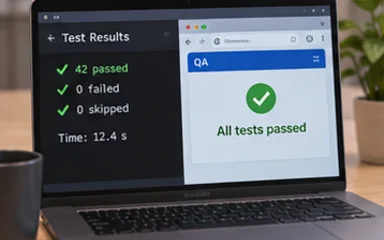
Review the Playwright architecture and set up the TypeScript project.
Explore the course learning planHandle more complex browser interactions and organise reusable test data.
Explore the course learning planDescribe expected behaviour in feature files and connect scenarios to step definitions.
Explore the course learning planReview the Playwright architecture and set up the TypeScript project. Participants also create and run initial tests and inspect their results. The section also examines Languages supported by Playwright, Configuring system with typescript, and creating project folder & package.json file. Connect each test to an expected behaviour and consider what its result demonstrates, including the limits of the scenario and the setup used.
Use selectors and assertions to validate expected behaviour in the browser. The discussion covers Capture and review traces to diagnose test failures, Recording Playwright spec file using codegen, and Object identification techniques including CSS & xpath. The section also examines Finding elements using different locators. Connect the checks to the expected application behaviour, distinguishing the test setup, the action performed and the result that would indicate success or failure.
Handle more complex browser interactions and organise reusable test data. Participants also review state and session storage as part of checking application behaviour. The section also examines Hard & soft assertions, Testing localized language page, and Testing mobile web page through request header. Connect each test to an expected behaviour and consider what its result demonstrates, including the limits of the scenario and the setup used.
Practise browser and context interactions for realistic application scenarios. Participants also build API checks and review performance measurements in the test environment. Relate observations to the original symptom or performance goal, and distinguish evidence about system behaviour from assumptions about its cause. Explain how these topics fit together and which assumptions need to be made explicit when applying them in a workplace setting.
Describe expected behaviour in feature files and connect scenarios to step definitions. Participants also run and review the suite through Jenkins. The section also examines creating feature files, scenarios, creating cucumber step definitions with Playwright code, and Running cucumber feature files. Connect each test to an expected behaviour and consider what its result demonstrates, including the limits of the scenario and the setup used.
The published outline groups these topics by module, session or combined days. The sections cover the 6 days programme; confirm the final day-by-day timetable with Timmins.
Need the detailed syllabus? Request the course outline.
Check the course fit for your role and experience. Confirm the prerequisites, delivery scope and preparation before booking.
Check the full outline for this course’s tools and technologies. Confirm software versions, licences, accounts, equipment, access and installation requirements before joining.
Ask which preparation materials, follow-up resources or trainer support are included in your selected delivery.
Confirm the certificate, completion requirements and any assessed activities for your selected batch. A practical project does not by itself establish an assessed skills award.
Understand certificates and assessments →Confirm dates, venue, fees, available seats and delivery arrangements with Timmins before booking.
Ask Timmins about upcoming dates for this course.
View the public training calendar →Ask about another date or team delivery. Share your preferred timeframe, city or delivery mode and participant numbers. Timmins will discuss the options; dates, trainer availability, delivery and fees must be confirmed separately. Sending an enquiry does not reserve a place or confirm a class.
Your selected course is included in the draft. Review it and press Send in your messaging app.
Test automation engineers, QA teams and developers designing Playwright suites with behaviour-driven scenarios.
Software testing concepts and CSS and XPath basics. TypeScript, Selenium or Cypress familiarity is useful.
Check the full outline for this course’s tools and technologies. Confirm software versions, licences, accounts, equipment, access and installation requirements before joining.
The learning plan describes the course topics and activities in the published summary. Ask Timmins to confirm the exercises, trainer feedback and any assessed activities for your selected delivery. Completion and assessed credentials have different requirements.
AI-assisted activities are not listed in this course summary. Ask Timmins to confirm the scope of your selected delivery rather than assuming AI tools are included.
Discuss an in-house programme with Timmins. Share the team’s roles, starting knowledge and workplace challenges. Agree any adaptations, assessment and follow-up support in the proposal.