Real-time tasks and scheduling
Create FreeRTOS tasks and examine how priorities and scheduling affect responsiveness.
See the detailed course outline Training & Capability DevelopmentLearn. Practise. Apply.⌕
Create and schedule FreeRTOS tasks.
Design responsive FreeRTOS firmware. Practise coordinating tasks, sharing resources and handling interrupts.
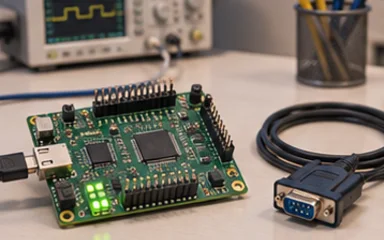
Create FreeRTOS tasks and examine how priorities and scheduling affect responsiveness.
See the detailed course outlineReview task memory and stack use, and coordinate shared access with mutexes and semaphores.
See the detailed course outlinePass events with queues and other FreeRTOS primitives. See how interrupt-to-task communication affects firmware behaviour.
See the detailed course outlineCompare general purpose and real time operating systems, then examine timing constraints and FreeRTOS architecture. Set up the build environment and work through task creation, deletion, states and priorities. Explore scheduling, task context and switching, including the idle task and hooks. Practical activities connect these mechanisms with the task lifecycle, giving participants a basis for understanding how a FreeRTOS application divides and schedules its work.
Explore FreeRTOS memory managers and stack overflow detection, including the relevant callback and heap techniques. Continue into critical sections, mutexes and semaphores, comparing approaches to controlling shared resources. Case work examines priority inversion, inheritance and gatekeeper tasks. The outlined exercises connect memory diagnostics with synchronisation choices so participants can investigate failures caused by resource contention or unsuitable assumptions about task execution order.
Work with semaphores, queues, event groups, task notifications and message or stream buffers to coordinate FreeRTOS tasks. Exercises connect shared data updates with notifications and demonstrate the communication mechanisms. Introduce interrupt types, acknowledgement, nesting and deferred processing, including ISR safe functions and communication from handlers. The day relates asynchronous hardware events to scheduled task work and the mechanisms that move data or signal completion between them.
Need the detailed syllabus? Request the course outline.
Check prerequisites and confirm the course fit with Timmins for your role, experience and selected delivery.
Check the course outline for the software, development environment and any target hardware. Confirm installation steps, versions, equipment access and lab arrangements before joining.
Ask which preparation materials, follow-up resources or trainer support are included in your selected delivery.
Confirm the certificate, completion requirements and any assessed activities for your selected batch. A practical project does not by itself establish an assessed skills award.
Understand certificates and assessments →Confirm dates, venue, fees, available seats and delivery arrangements with Timmins before booking.
Ask Timmins about upcoming dates for this course.
View the public training calendar →Ask about another date or team delivery. Share your preferred timeframe, city or delivery mode and participant numbers. Timmins will discuss the options; dates, trainer availability, delivery and fees must be confirmed separately. Sending an enquiry does not reserve a place or confirm a class.
Your selected course is included in the draft. Review it and press Send in your messaging app.
Firmware developers building multitasking or event-driven applications with FreeRTOS.
Working proficiency in embedded C programming.
Check the outline and confirm the software environment, hardware, equipment access and setup requirements for your selected delivery. Do not assume all courses use the same board or lab environment.
The course topics describe the technical scope. Ask Timmins to confirm the labs, demonstrations and any assessed activities for your selected programme. Completion and assessed credentials have different requirements.
Discuss an in-house session with Timmins. Share the team’s roles, systems and intended outcomes so the scope, prerequisites, delivery and any adaptations can be agreed.