5G Introduction Revisited
Explore 5G introduction revisited, 5G-LTE dual connectivity, and 5G Non-Standalone architecture.
Explore the course learning plan Training & Capability DevelopmentLearn. Practise. Apply.⌕
Design and sketch 5G network architecture, including protocols and 5G-LTE dual connectivity.
The course delves into the methods, procedures, and tools essential for Radio Network Planning (RNP) in 5G networks, addressing the advanced requirements introduced by the 5G standard.
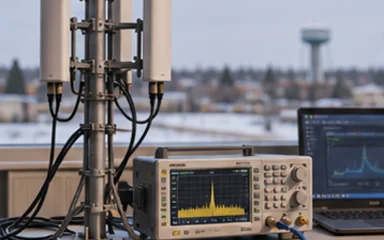
Explore 5G introduction revisited, 5G-LTE dual connectivity, and 5G Non-Standalone architecture.
Explore the course learning planExplore Initial parameter planning, concept of channel configuration parameters, and Practical session on tool.
Explore the course learning planExplore Practical session on tool (Continued), Coordinated multipoint (CoMP) transmission and reception, and advanced bearer and service modelling.
Explore the course learning planExplore 5G introduction revisited, 5G-LTE dual connectivity, and 5G Non-Standalone architecture. The discussion covers 5G Air interface, 5G physical layer aspects, and stand-Alone (SA) and Non-Standalone (NSA). The section also examines 3x Split SCG Bearer, NSA 3x 5G/LTE Features, and 5G Requirements. The discussion covers 5G Spectrum. Connect the foundational ideas to the examples in the section, distinguishing the responsibility of each component before considering how they work together in a system.
Explore Radio access point profile (rapProfile), Outputs of VNF Dimensioning, and RAP capacity calculation. The discussion covers Number of Subscribers per gNB-DU/Classical gNB, Control plane events per gNB-DU/Classical gNB, and BHCA per gNB-DU/Classical gNB. The section also examines Inputs for VNF Dimensioning, VNF dimensioning process overview, and Number of VNF/gNB-CU Calculations.
Explore Initial parameter planning, concept of channel configuration parameters, and Practical session on tool. The discussion covers Network modelling for All 5G NR frequency bands both below and above 6 GHz, NR PRACH configuration parameters, and NR PCI configuration parameters. The section also examines UL DM & RS of PDSCH/PDCCH/PUCCH SS-PBCH configuration parameters and Network modelling for TDD, FDD, SUL, and SDL duplex modes.
Explore Practical session on tool (Continued), Network modelling for All 5G NR Self-Contained slot formats, and Network modelling for standalone (SA) and Non-Standalone (NSA) deployments. The discussion covers Network modelling for Multi-Layer network deployments, intra- and Inter-Band carrier aggregation, and Dual connectivity (5G NR + LTE). Follow the relationship between configuration and execution, identifying which component runs the workload and which dependencies must be available for it to operate.
Explore Practical session on tool (Continued), Coordinated multipoint (CoMP) transmission and reception, and advanced bearer and service modelling. The discussion covers Massive MIMO: SU-MIMO, MU-MIMO, and Transmit/Receive diversity, C-RAN Architecture, and 3D Beamforming. Relate the component structure and interactions to the task a user needs to complete, tracing how input and state affect what the application displays.
Need the detailed syllabus? Request the course outline.
Check the course fit for your role and experience. Confirm the prerequisites, delivery scope and preparation before booking.
Check the full outline for this course’s tools and technologies. Confirm software versions, licences, accounts, equipment, access and installation requirements before joining.
Ask which preparation materials, follow-up resources or trainer support are included in your selected delivery.
Confirm the certificate, completion requirements and any assessed activities for your selected batch. A practical project does not by itself establish an assessed skills award.
Understand certificates and assessments →Confirm dates, venue, fees, available seats and delivery arrangements with Timmins before booking.
Ask Timmins about upcoming dates for this course.
View the public training calendar →Ask about another date or team delivery. Share your preferred timeframe, city or delivery mode and participant numbers. Timmins will discuss the options; dates, trainer availability, delivery and fees must be confirmed separately. Sending an enquiry does not reserve a place or confirm a class.
Your selected course is included in the draft. Review it and press Send in your messaging app.
Radio Network Planning Engineers, RF Engineers, and Radio Performance Engineers.
Basic understanding of telecom, 3G, 4G LTE technology. Familiarity with LTE Air Interface. Fundamental knowledge of 5G planning.
Check the full outline for this course’s tools and technologies. Confirm software versions, licences, accounts, equipment, access and installation requirements before joining.
The learning plan describes the course topics and activities in the published summary. Ask Timmins to confirm the exercises, trainer feedback and any assessed activities for your selected delivery. Completion and assessed credentials have different requirements.
AI-assisted activities are not listed in this course summary. Ask Timmins to confirm the scope of your selected delivery rather than assuming AI tools are included.
Discuss an in-house programme with Timmins. Share the team’s roles, starting knowledge and workplace challenges. Agree any adaptations, assessment and follow-up support in the proposal.